Ride Notes: The Commuter Shootout—Trip vs. Ember Urban vs. AB Maze
The Contenders
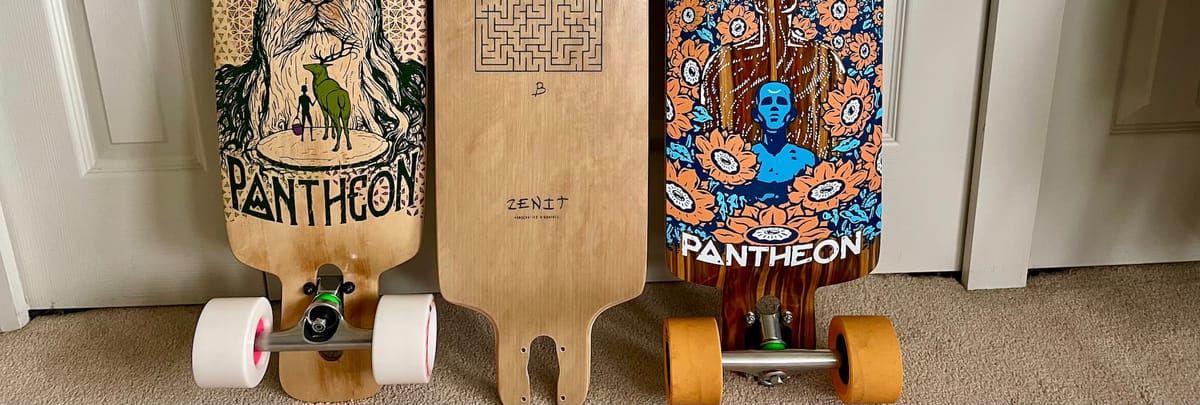
Three boards are vying for my ultimate commuter title. All three are double-drop decks in the 33" range.
Setup 1 — Pantheon Trip (the baseline)
- Deck: Pantheon Trip — 33.25" × 9", wheelbase 27.25"
- Drop: 1.26" (+ drop-through)
- Trucks: Paris V3 150mm RKP — 50° front / 43° rear
- Wheels: Seismic Speed Vent 85mm Mango Defcon
- Miles logged: ~100
- Use case: Commuting / LDP / carving / mixed
Setup 2 — Pantheon Ember Urban (the contender)
- Deck: Pantheon Ember Urban — 33.2" × 8.5", wheelbase 25"
- Drop: 0.75" (+ drop-through)
- Trucks: Ace AF1 44 Hollow TKP — 8.25" axle
- Wheels: 88 Wheel Co McFly Pro 86mm
- Miles logged: 10
- Use case: Commuting / LDP / cruising / carving
Setup 3 — Zenit AB Maze 2.0 (on deck)
- Deck: Zenit AB Maze 2.0 — 33.25" × 8.75", wheelbase 28.5"
- Drop: 1" (+ drop-through)
- Trucks: TBD — compatible with RKP and TKP
- Wheels: TBD
- Miles logged: Not ridden
- Use case: Commuting / LDP / mixed
Why This Comparison Exists
I've got 100 miles on the Trip. It's low, stable, and pushes and pumps. It's a great all-around longboard! That's my baseline—with RKP trucks. A long-term review is on the way.
The AB Maze is about the same length with 0.26" less drop. It works with both RKP and TKP trucks. Trucks and wheels TBD.
The Ember Urban is the one I'm excited about. Slightly shorter, slightly thinner, lighter, flexier (to soak up the bumps), with a small kicktail for throw-downs and pickups—and 8.25" Ace AF1 Hollow TKP trucks. On this deck, the Ace trucks offer the same wheel clearance as the Paris 150s on the Trip. Ace trucks also feature tall bushings (14mm boardside / 12mm roadside) that lend themselves to tuning.
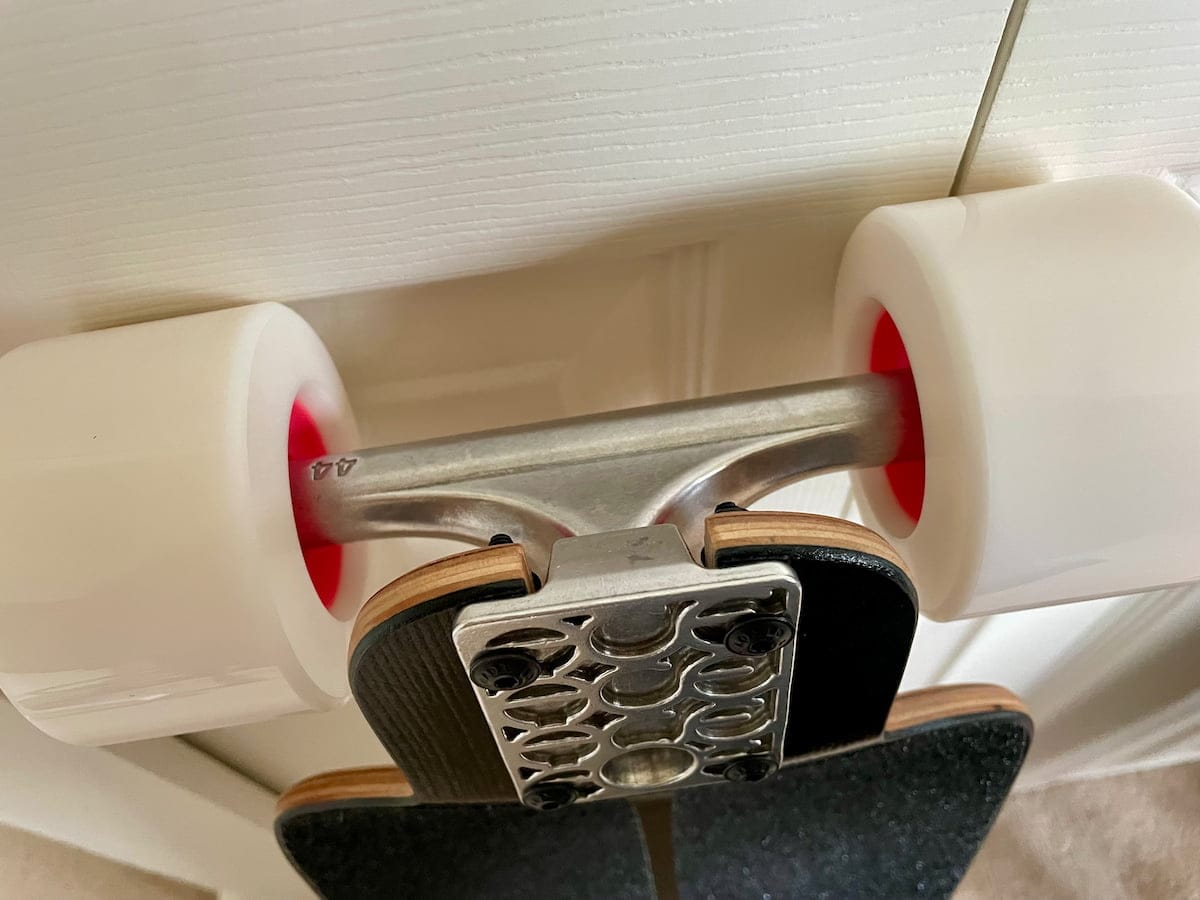
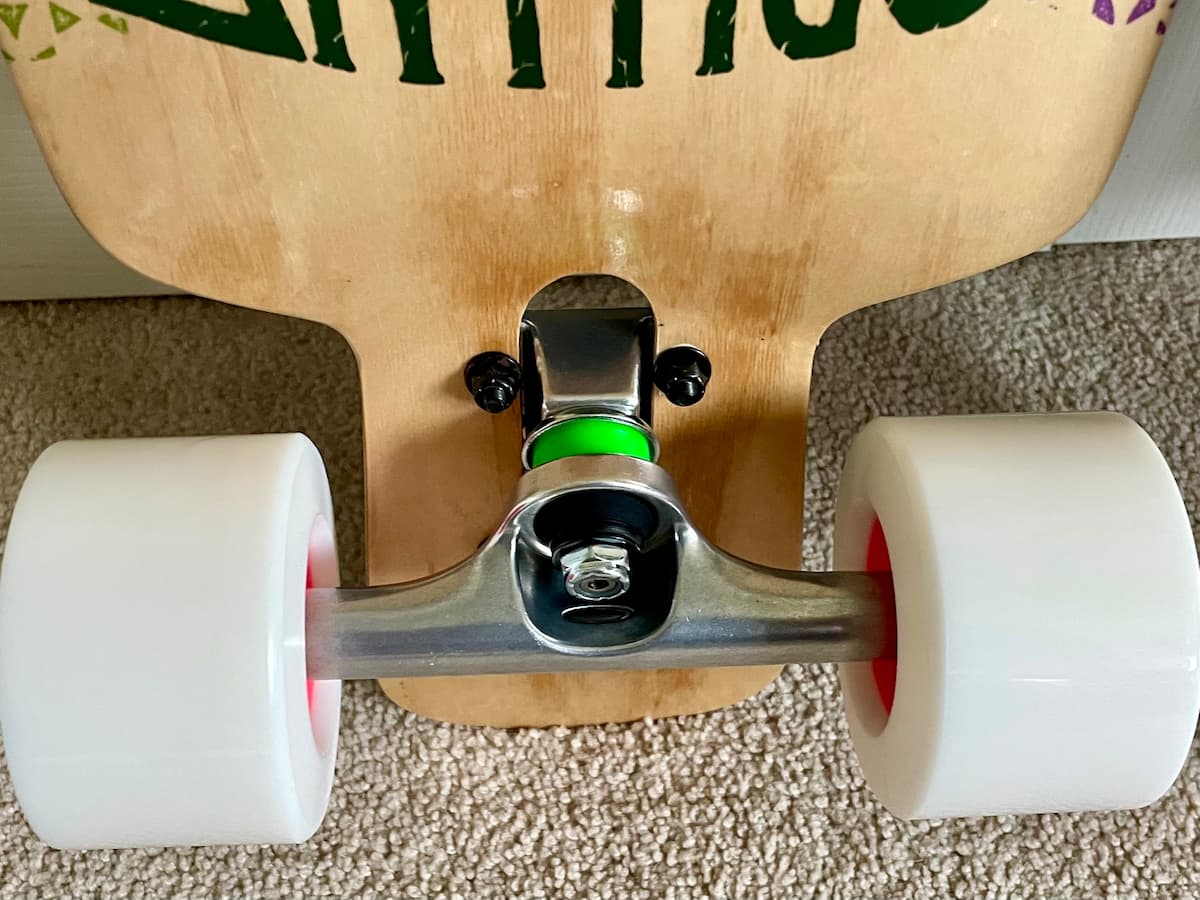
Ace AF1 Hollow 44 (8.25") trucks on the Ember Urban. Venom and Bones bushing combo.
First Impressions — Ember Urban
Test conditions: Cloudy, ~79°F, warm and humid. Dry pavement. Smooth bike paths; smooth and cracked asphalt. About me: 6' tall, 190lbs, size 11 shoes.
The initial ride impression on the Ember is that it's downright fun and will make for a fantastic commuter. The Trip might have the edge on high-speed pushing stability (with similar durometer bushings in the trucks), but it's really close.
What the Ember Is Doing Well (So Far)
- Weight. The Ember is roughly 10.5 oz (300g) lighter than the Trip. You feel it in acceleration and when you pick up the board.
- Acceleration. The Ember gets moving a little quicker, probably because it's 9% lighter.
- The kicktail. Throw-downs, pickups, curb navigation. Although small, it adds utility for commuting.
- Fun factor. It's nimble. The wheelbase and Ace TKP trucks make it playful in a way the Trip doesn't try to be.
- Pushing and steering. It's easier to steer with one foot on the deck. I appreciate the trucks are contributing more to this than the deck.
Tradeoffs / Limitations
Not dealbreakers, just realities.
- No pumping. The Trip, with 50° and 43° Paris RKP trucks, can pump. You can push, then pump to maintain momentum. The Ember on TKPs can't. That's a meaningful difference on long rides.
- High-speed stability. The Trip has the edge here, and it will always have the edge bombing hills. The longer wheelbase and RKP trucks are more composed when things get fast.
- Turn character. The Ace trucks on the Ember turn more with less body lean. I'm looking forward to watching some slow-motion GoPro footage and seeing if I'm angling my feet more, or they're simply more agile. Initiation is faster, too. The RKPs on the Trip feel linear and gradual. The RKP vs. TKP comparison is debated across websites, forums and social media, and your experience may differ. Under me, the TKPs are snappier.
Board Sport Comparisons
These clicked for me, so maybe they'll click for you.
Snowboarding: Carving long turns in powder = Trip. Jibbing and buttering = Ember.
Surfing: Gliding like a longboard or drawing top-to-bottom lines like a mid-length = Trip. Double-pumping the bottom turn while eyeing where to whack the lip = Ember.
The Numbers
This is long-wheelbase skateboarding, so the wheelbases matter! (So do the drops.)
| Pantheon Trip | Zenit AB Maze 2.0 | Pantheon Ember Urban | |
|---|---|---|---|
| Length | 33.25" | 33.25" | 33.2" |
| Width | 9" | 8.75" | 8.5" |
| Wheelbase | 27.25" | 28.5" | 25" |
| Drop | 1.26" | 1" | 0.75" |
| Truck type | RKP | RKP or TKP | TKP |
About those drops:
The Pantheon Trip has a 1.26" drop and rides on RKP trucks. The Zenit AB Maze has a 1" drop (0.26" less) and works with RKP or TKP trucks. The Pantheon Ember Urban has a 0.75" drop and rides on TKP trucks. Because TKP trucks sit lower, the Ember ends up at roughly the same ride height and deck-to-ground clearance as the Trip despite the shallower drop.
Who Each Board Might Be For
This is directional guidance only since I haven't finished my testing.
- If you want to cruise, carve, push on flat ground, or roll some small hills, the Ember is a sensational choice. The size, flex, kicktail and light weight make it a natural commuter.
- If you want high-speed stability, the ability to pump, or you're bombing hills, the Trip will always have the edge. It's a more versatile distance board.
- If you want the option to experiment with both truck types on one deck, the AB Maze 2.0 is an interesting wildcard. More to come.
Open Questions / Things I'm Watching
- How does the Ember hold up over longer distances (10+ miles) without pumping to supplement pushes?
- What trucks and wheels will bring the AB Maze to life? Where does it land relative to the other two?
- Does the Trip's stability edge actually matter at commuting speeds, or only when things get steep and fast?
- How do the Ace AF1 bushings respond to tuning?
Will This Become a Full Review?
A Trip long-term review is already in progress. If the Ember keeps earning ride time—and it will—it'll get one too. The AB Maze 2.0 needs trucks, wheels and miles before I can say anything useful.
Related Gear
Decks
Trucks
Wheels
Glossary
New to longboarding? Here's a quick orientation for terms used in this post.
Double-drop — A deck that's lowered in two ways: the trucks mount through the board (drop-through), and the standing platform is also physically dropped below the truck mounts (a "drop" or "crescent drop"). The result is a very low ride height, which makes pushing easier, more stable, and more efficient.
RKP (Reverse Kingpin) — A truck style where the kingpin bolt angles outward through the hanger. Standard on most longboards. Generally taller than TKPs, with a turn feel often described as smooth or surfy. Better suited to higher speeds and pumping.
TKP (Traditional Kingpin) — A truck style where the kingpin bolt sits behind the hanger, like a traditional skateboard truck. Sit lower to the ground than RKPs, which is why they're popular on commuter decks—they get the board closer to the pavement. TKPs have a progressive turn: loose and a bit vague in the center, but the more you lean, the sharper the turn. RKPs feel more linear: they start turning the moment you lean and respond proportionally throughout.
LDP (Long Distance Pushing) — Riding long distances under your own power. Efficient setups prioritize low ride height, large wheels, and minimal energy loss per push.
Commuting — Using a longboard to get from A to B. Similar priorities to LDP but usually shorter distances, with more emphasis on portability (carrying the board on a bus or train), maneuverability in traffic, and convenience (kicktail for pickup, fits under a desk).
Carving — Linking deep, surf-style turns while riding. On flat ground, carving trades some forward speed for the pure fun of flowing side to side.
Pumping — Generating and maintaining forward momentum without pushing, by weighting and unweighting through turns. Requires trucks with enough turn and rebound—typically RKPs with split angles (e.g., 50° front / 30° rear). Most TKP setups can't pump effectively.
Wheelbase — The distance between the two truck mounting points. Longer wheelbases are more stable; shorter wheelbases are more maneuverable. All three boards in this comparison have wheelbases in the 25"–28.5" range, which is long by skateboard standards but typical for distance-oriented longboards. (Popsicle skateboards for tricks have ~14" wheelbases.)
Drop — The vertical distance between the truck mounting surface and the lowest point of the standing platform. More drop = lower ride height = less knee bend per push = less fatigue over distance.
Throw-down — Dropping the board onto the ground while stepping onto it in one motion. Kind of like a running start. A kicktail makes this easier and more controlled.
Pickup — Kicking the tail to pop the board into your hand when you stop. Easier than bending down to grab the deck.